Coral Reefs: Minor Ecosystem, Mayor Effect.
- Ardian Cahyo Pambudi

- Jul 6, 2018
- 16 min read

A lot of people still can’t distinguish between corals, reefs and coral reefs. They are relate to each other into one cohesion and become an ecosystem that supports marine life. Coral reefs only exist in tropical weather, like Indonesia and Australia. Famous with triangle reef beside Indonesia and Great Barrier Reefs in Australia. Really exciting to study with. There is a plenty resources that we can process for human needs. So lets set it up.
What are coral?
Almost all corals are colonial organisms. This means that they are composed of hundreds to hundreds of thousands of individual animals, called polyps (Barnes, R.D., 1987; Lalli and Parsons, 1995). Each polyp has a stomach that opens at only one end. This opening, called the mouth, is surrounded by a circle of tentacles. The polyp uses these tentacles for defense, to capture small animals for food, and to clear away debris. Food enters the stomach through the mouth. After the food is consumed, waste products are expelled through the same opening (Barnes, R.D., 1987; Levinton, 1995).

Most corals feed at night (Barnes, 1987). To capture their food, corals use stinging cells called nematocysts. These cells are located in the coral polyp’s tentacles and outer tissues. If you’ve ever been “stung” by a jellyfish, you’ve encountered nematocysts. This is seriously dangerous. Nematocysts are capable of delivering powerful, often lethal, toxins, and are essential in capturing prey (Barnes, R.D., 1987). A coral's prey ranges in size from nearly microscopic animals called zooplankton to small fish, depending on the size of the coral polyps. In addition to capturing zooplankton and larger animals with their tentacles, many corals also collect fine organic particles in mucous film and strands, which they then draw into their mouths (Barnes and Hughes, 1999).

What Are Zooxanthellae?
Most reef-building corals contain photosynthetic algae, called zooxanthellae, that live in their tissues. The corals and algae have a mutualistic relationship. The coral provides the algae with a protected environment and compounds they need for photosynthesis. In return, the algae produce oxygen and help the coral to remove wastes. Most importantly, zooxanthellae supply the coral with glucose, glycerol, and amino acids, which are the products of photosynthesis. The coral uses these products to make proteins, fats, and carbohydrates, and produce calcium carbonate (Barnes, R.D., 1987; Barnes, R.S.K. and Hughes, 1999; Lalli and Parsons, 1995; Levinton, 1995; Sumich, 1996). The relationship between the algae and coral polyp facilitates a tight recycling of nutrients in nutrient-poor tropical waters. In fact, as much as 90 percent of the organic material photosynthetically produced by the zooxanthellae is transferred to the host coral tissue (Sumich, 1996). This is the driving force behind the growth and productivity of coral reefs (Barnes, 1987; Levinton, 1995).

In addition to providing corals with essential nutrients, zooxanthellae are responsible for the unique and beautiful colors of many stony corals. Sometimes when corals become physically stressed, the polyps expel their algal cells and the colony takes on a stark white appearance. This is commonly described as “coral bleaching” (Barnes, R.S.K. and Hughes, 1999; Lalli and Parsons, 1995). If the polyps go for too long without zooxanthellae, coral bleaching can result in the coral's death. Because of their intimate relationship with zooxanthellae, reef-building corals respond to the environment like plants. Because their algal cells need light for photosynthesis, reef corals require clear water. For this reason they are generally found only in waters with small amounts of suspended material, i.e., in water of low turbidity and low productivity. This leads to an interesting paradox—coral reefs require clear, nutrient-poor water, but they are among the most productive and diverse marine environments (Barnes, 1987).


Over the course of many years, stony coral polyps can create massive reef structures. Reefs form when polyps secrete skeletons of calcium carbonate (CaCO3). Most stony corals have very small polyps, averaging 1 to 3 millimeters in diameter, but entire colonies can grow very large and weigh several tons. As they grow, these reefs provide structural habitats for hundreds to thousands of different vertebrate and invertebrate species.
The skeletons of stony corals are secreted by the lower portion of the polyp. This process produces a cup, or calyx, in which the polyp sits. The walls surrounding the cup are called the theca, and the floor is called the basal plate. Periodically, a polyp will lift off its base and secrete a new basal plate above the old one, creating a small chamber in the skeleton. While the colony is alive, CaCO3 is deposited, adding partitions and elevating the coral.
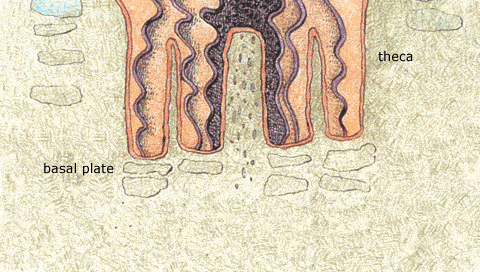
When polyps are physically stressed, they contract into their calyx so that virtually no part is exposed above their skeleton. This protects the polyp from predators and the elements (Barnes, R.D., 1987; Sumich, 1996). At other times, polyps extend out of the calyx. Most polyps extend the farthest when they feed.
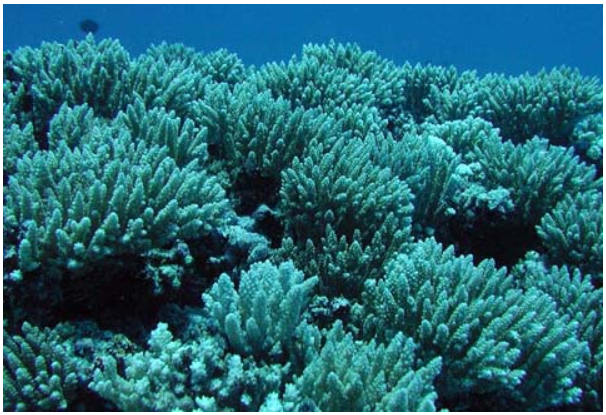
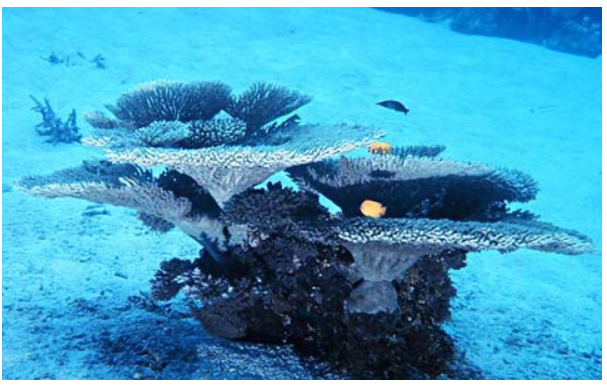
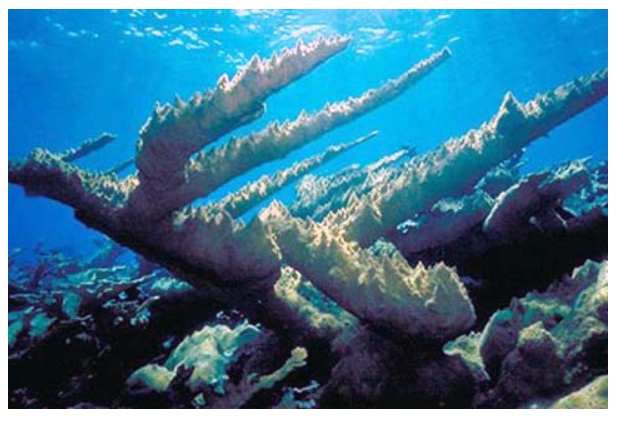
Reef-building corals exhibit a wide range of shapes. For instance, Branching corals have primary and secondary branches. Digitate corals look like fingers or clumps of cigars and have no secondary branches. Table corals form table-like structures and often have fused branches. Elkhorn coral has large, flattened branches. Foliase corals have broad plate-like portions rising in whorl-like patterns. Encrusting corals grow as a thin layer against a substrate. Massive corals are ball-shaped or boulder-like and may be small as an egg or as large as a house. Mushroom corals resemble the attached or unattached tops of mushrooms.





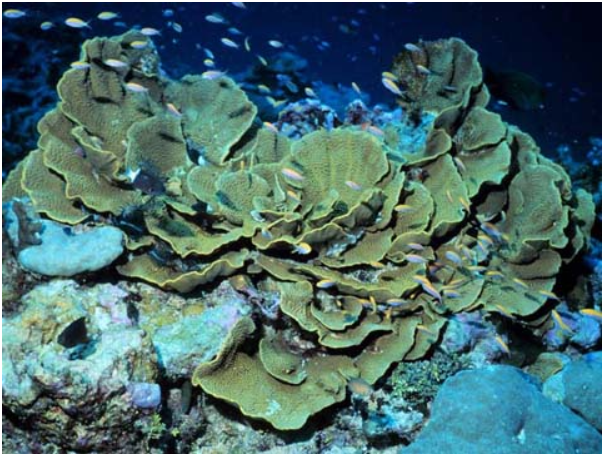




Coral reefs begin to form when free-swimming coral larvae attach to submerged rocks or other hard surfaces along the edges of islands or continents. As the corals grow and expand, reefs take on one of three major characteristic structures —fringing, barrier or atoll. Fringing reefs, which are the most common, project seaward directly from the shore, forming borders along the shoreline and surrounding islands. Barrier reefs also border shorelines, but at a greater distance. They are separated from their adjacent land mass by a lagoon of open, often deep water. If a fringing reef forms around a volcanic island that subsides completely below sea level while the coral continues to grow upward, an atoll forms. Atolls are usually circular or oval, with a central lagoon. Parts of the reef platform may emerge as one or more islands, and gaps in the reef provide access to the central lagoon (Lalli and Parsons, 1995; Levinton, 1995; Sumich, 1996).
In addition to being some of the most beautiful and biologically diverse habitats in the ocean, barrier reefs and atolls also are some of the oldest. With growth rates of 0.3 to 2 centimeters per year for massive corals, and up to 10 centimeters per year for branching corals, it can take up to 10,000 years for a coral reef to form from a group of larvae (Barnes, 1987). Depending on their size, barrier reefs and atolls can take from 100,000 to 30,000,000 years to fully
All three reef types—fringing, barrier and atoll—share similarities in their biogeographic profiles. Bottom topography, depth, wave and current strength, light, temperature, and suspended sediments all act to create characteristic horizontal and vertical zones of corals, algae and other species. These zones vary according to the location and type of reef. The major divisions common to most reefs, as they move seaward from the shore, are the reef flat, reef crest or algal ridge, buttress zone, and seaward slope.
Over time, many coral reefs develop similar biogeographic profiles. Moving seaward from the shore, the reef flat, reef crest, buttress zone and seaward slope form the major divisions common to most reefs. The reef flat is on the sheltered side of the reef. The substrate is formed of coral rock and loose sand, and large parts may be exposed during low tides. The reef crest, or algal ridge, is the highest point of the reef, and is almost always exposed at low tide. The reef crest is exposed to the full fury of incoming waves, and living corals are practically nonexistent here. Small crabs, shrimps, and other animals often live in the cavities under the reef crest, protected from waves and predators. The buttress zone is a rugged area of spurs, or buttresses, radiating out from the reef. Deep channels that slope down the reef face are interspersed between the buttresses. The buttress zone acts to dissipate the tremendous force of unabating waves and stabilizes the reef structure. The buttress zone also drains debris and sediment off the reef and into deeper water. The dropoff of a reef slope can extend hundreds of feet downward. While light intensity decreases, reduced wave action allows greater numbers of coral species to develop. Sponges, sea whips, sea fans, and non-reef-building corals become abundant and gradually replace stony corals in deeper, darker water.

Reef-building corals are restricted in their geographic distribution by their physiology. For instance, reef-building corals cannot tolerate water temperatures below 18° Celsius (C). Many grow optimally in water temperatures between 23° and 29° C, but some can tolerate temperatures as high as 40° C for short periods. Most also require very saline (salty) water ranging from 32 to 42 parts per thousand, which must also be clear so that a maximum amount of light penetrates it. The corals’ requirement for high light also explains why most reef-building species are restricted to the euphotic zone, the region in the ocean where light penetrates to a depth of approximately 70 meters (Lalli and Parsons, 1995).
All three reef types—fringing, barrier and atoll—share similarities in their biogeographic profiles. Bottom topography, depth, wave and current strength, light, temperature, and suspended sediments all act to create characteristic horizontal and vertical zones of corals, algae and other species. These zones vary according to the location and type of reef. The major divisions common to most reefs, as they move seaward from the shore, are the reef flat, reef crest or algal ridge, buttress zone, and seaward slope.
How They Produce?
Corals can reproduce asexually and sexually. In asexual reproduction, new clonal polyps bud off from parent polyps to expand or begin new colonies (Sumich, 1996). This occurs when the parent polyp reaches a certain size and divides. This process continues throughout the animal’s life (Barnes and Hughes, 1999).
About three-quarters of all stony corals produce male and/or female gametes. Most of these species are broadcast spawners, releasing massive numbers of eggs and sperm into the water to distribute their offspring over a broad geographic area (Veron, 2000). The eggs and sperm join to form free-floating, or planktonic, larvae called planulae. Large numbers of planulae are produced to compensate for the many hazards, such as predators, that they encounter as they are carried by water currents. The time between planulae formation and settlement is a period of exceptionally high mortality among corals (Barnes and Hughes, 1999).

Along many reefs, spawning occurs as a mass synchronized event, when all the coral species in an area release their eggs and sperm at about the same time. The timing of a broadcast spawning event is very important because males and female corals cannot move into reproductive contact with each other. Because colonies may be separated by wide distances, this release must be both precisely and broadly timed, and usually occurs in response to multiple environmental cues (Veron, 2000).
The long-term control of spawning may be related to temperature, day length and/or rate of temperature change (either increasing or decreasing). The short-term (getting ready to spawn) control is usually based on lunar cues. The final release, or spawn, is usually based on the time of sunset (Veron, 2000).
Planulae swim upward toward the light (exhibiting positive phototaxis), entering the surface waters and being transported by the current. After floating at the surface, the planulae swim back down to the bottom, where, if conditions are favorable, they will settle (Barnes and Hughes, 1999). Once the planulae settle, they metamorphose into polyps and form colonies that increase in size. In most species, the larvae settle within two days, although some will swim for up to three weeks, and in one known instance, two months (Jones and Endean, 1973).
The Importance of Coral Reefs
Coral reefs are some of the most diverse and valuable ecosystems on Earth. Coral reefs support more species per unit area than any other marine environment, including about 4,000 species of fish, 800 species of hard corals and hundreds of other species. Scientists estimate that there may be another 1 to 8 million undiscovered species of organisms living in and around reefs (Reaka-Kudla, 1997). This biodiversity is considered key to finding new medicines for the 21st century. Many drugs are now being developed from coral reef animals and plants as possible cures for cancer, arthritis, human bacterial infections, viruses, and other diseases.
Storehouses of immense biological wealth, reefs also provide economic and environmental services to millions of people. Coral reefs may provide goods and services worth $375 billion each year. This is an amazing figure for an environment that covers less than 1 percent of the Earth’s surface (Costanza et al., 1997).
Healthy reefs contribute to local economies through tourism. Diving tours, fishing trips, hotels, restaurants, and other businesses based near reef systems provide millions of jobs and contribute billions of dollars all over the world. Recent studies show that millions of people visit coral reefs in the Florida Keys every year. These reefs alone are estimated to have an asset value of $7.6 billion (Johns et al., 2001).
The commercial value of U.S. fisheries from coral reefs is over $100 million (NMFS/NOAA, 2001). In addition, the annual value of reef-dependent recreational fisheries probably exceeds $100 million per year. In developing countries, coral reefs contribute about one-quarter of the total fish catch, providing critical food resources for tens of millions of people (Jameson et al., 1995).
Coral reefs buffer adjacent shorelines from wave action and prevent erosion, property damage and loss of life. Reefs also protect the highly productive wetlands along the coast, as well as ports and harbors and the economies they support. Globally, half a billion people are estimated to live within 100 kilometers of a coral reef and benefit from its production and protection.
Natural Threats to Coral Reefs
Coral reefs face numerous threats. Weather-related damage to reefs occurs frequently. Large and powerful waves from hurricanes and cyclones can break apart or flatten large coral heads, scattering their fragments (Barnes & Hughes, 1999; Jones & Endean, 1976). A single storm seldom kills off an entire colony, but slow-growing corals may be overgrown by algae before they can recover (UVI, 2001).
Reefs also are threatened by tidal emersions. Long periods of exceptionally low tides leave shallow water coral heads exposed, damaging reefs. The amount of damage depends on the time of day and the weather conditions. Corals exposed during daylight hours are subjected to the most ultraviolet radiation, which can overheat and dry out the coral's tissues. Corals may become so physiologically stressed that they begin to expel their symbiotic zooxanthellae, which leads to bleaching, and in many cases, death (Barnes & Huges, 1999).
Increased sea surface temperatures, decreased sea level and increased salinity from altered rainfall can all result from weather patterns such as El Niño. Together these conditions can have devastating effects on a coral’s physiology (Forrester, 1997.) During the 1997-1998 El Niño season, extensive and severe coral reef bleaching occurred in the Indo-Pacific and Caribbean. Approximately 70 to 80 percent of all shallow-water corals on many Indo-Pacific reefs were killed. (NMFS Office of Protected Resources, 2001).
In addition to weather, corals are vulnerable to predation. Fish, marine worms, barnacles, crabs, snails and sea stars all prey on the soft inner tissues of coral polyps (Jones & Endean, 1976). In extreme cases, entire reefs can be devastated by this kind of predation. In 1978 and 1979, a massive outbreak of crown-of-thorns starfish (Acanthaster planci) attacked the reef at the Fagatele Bay National Marine Sanctuary in American Samoa. Approximately 90 percent of the corals were destroyed.

Coral reefs may recover from periodic traumas caused by weather or other natural occurrences. If, however, corals are subjected to numerous and sustained stresses including those imposed by people, the strain may be too much for them to endure, and they will perish.
Anthropogenic Threats to Corals
Human-caused, or anthropogenic activities are major threats to coral reefs. Pollution, overfishing, destructive fishing practices using dynamite or cyanide, collecting live corals for the aquarium market and mining coral for building materials are some of the many ways that people damage reefs all around the world every day. (Bryant et al., 1998)
One of the most significant threats to reefs is pollution. Land-based runoff and pollutant discharges can result from dredging, coastal development, agricultural and deforestation activities, and sewage treatment plant operations. This runoff may contain sediments, nutrients, chemicals, insecticides, oil, and debris (UVI, 2001).
When some pollutants enter the water, nutrient levels can increase, promoting the rapid growth of algae and other organisms that can smother corals (Jones & Endean, 1976).
Coral reefs also are affected by leaking fuels, anti-fouling paints and coatings, and other chemicals that enter the water (UVI, 2001). Petroleum spills do not always appear to affect corals directly because the oil usually stays near the surface of the water, and much of it evaporates into the atmosphere within days. However, if an oil spill occurs while corals are spawning, the eggs and sperm can be damaged as they float near the surface before they fertilize and settle. So, in addition to compromising water quality, oil pollution can disrupt the reproductive success of corals, making them vulnerable to other types of disturbances. (Bryant, et al, 1998).
In many areas, coral reefs are destroyed when coral heads and brightly-colored reef fishes are collected for the aquarium and jewelry trade. Careless or untrained divers can trample fragile corals, and many fishing techniques can be destructive. In blast fishing, dynamite or other heavy explosives are detonated to startle fish out of hiding places. This practice indiscriminately kills other species and can crack and stress corals so much so that they expel their zooxanthellae. As a result, large sections of reefs can be destroyed. Cyanide fishing, which involves spraying or dumping cyanide onto reefs to stun and capture live fish, also kills coral polyps and degrades the reef habitat (NMFS Office of Protected Resources, 2001). More than 40 countries are affected by blast fishing, and more than 15 countries have reported cyanide fishing activities (ICRI, 1995).

Other damaging fishing techniques include deep water trawling, which involves dragging a fishing net along the sea bottom, and muro-ami netting, in which reefs are pounded with weighted bags to startle fish out of crevices. (Bryant, et al, 1998). Often, fishing nets left as debris can be problematic in areas of wave disturbance. In shallow water, live corals become entangled in these nets and are torn away from their bases (Coles, 1996). In addition anchors dropped from fishing vessels onto reefs can break and destroy coral colonies (Bryant, et al, 1998).
Coral Diseases
Coral diseases generally occur in response to biological stresses, such as bacteria, fungi and viruses, and nonbiological stresses, such as increased sea surface temperatures, ultraviolet radiation and pollutants. One type of stress may exacerbate the other (NMFS, 2001).
The frequency of coral diseases has increased significantly over the last 10 years, causing widespread mortality among reef-building corals. Many scientists believe the increase is related to deteriorating water quality associated with human-made pollutants and increased sea surface temperatures. These factors may allow for the proliferation and colonization of microbes. However, exact causes for coral diseases remain elusive. The onset of most diseases likely is a response to multiple factors (NMFS, 2001).

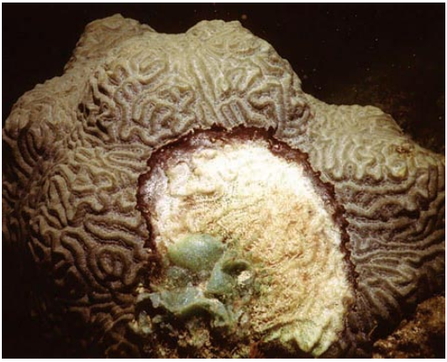

This large brain coral is being attacked by black-band disease. This disease is caused by a cyanobacteria, or blue-green algae, and manifests itself as an expanding black band over the surface of the coral. This is the only coral disease that can be successfully treated. (left)
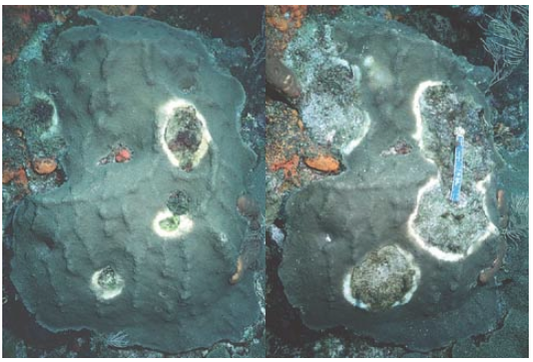
Yellow-band disease can rapidly spread over a coral destroying the delicate underlying tissues. On the left is a massive coral in the early stages of attack by yellow-band disease. On the right is the same coral several weeks later. Note how rapidly the area of destroyed tissue has expanded. (Photo: Andy Bruckner, NOAA)(right)
While the pathologies, or mechanisms by which many diseases act upon the coral polyp are not well known, the effects that these diseases have on corals has been well documented. Black-band disease, discolored spots, red-band disease, and yellow-blotch/band disease appear as discolored bands, spots or lesions on the surface of the coral. Over time, these progress across or expand over the coral’s surface consuming the living tissue and leaving the stark white coral skeleton in their wake. Other diseases, such as rapid wasting, white-band, white-plague and white-pox, often cause large patches of living coral tissue to slough off, exposing the skeleton beneath. Once exposed, the coral’s limestone skeleton can be a fertile breeding ground for algae and encrusting invertebrates. The colonization and overgrowth of the exposed coral skeleton by foreign organisms often results in the health of the entire colony taking a downward spiral from which it seldom recovers.
Protecting Coral Reefs

In 1998, the President of the United States established the Coral Reef Task Force (CRTF) to protect and conserve coral reefs. The CRTF is responsible for mapping and monitoring U.S. coral reefs; researching the causes of coral reef degradation including pollution and over fishing and finding solutions to these problems; and promoting conservation and the sustainable use of coral reefs. As a principle member of the CRTF, and as directed by the Coral Reef Conservation Act of 2000, NOAA has the responsibility to conserve coral reef ecosystems.
NOAA’s coral reef conservation efforts are carried out primarily through its Coral Reef Conservation Program (CRCP). Under this program, NOAA works with scientific, private, government, and nongovernmental organizations to achieve the goals of the CRTF.
Using high-resolution satellite imagery and Global Positioning Satellite (GPS) technology, NOAA has made detailed digital maps of reefs in Puerto Rico, the U.S. Virgin Islands, the eight main Hawaiian Islands and the Northwestern Hawaiian Islands. Satellite technology is also used to detect harmful algal blooms that can smother reefs and to monitor elevated sea surface temperatures, which can cause coral bleaching.
NOAA also monitors reefs using the Coral Reef Early Warning System (CREWS). This system consists of buoys deployed at reef sites that measure air temperature, wind speed and direction, barometric pressure, sea temperature, salinity, and tide levels. Every hour, these data are transmitted to scientists to help them understand conditions that may cause bleaching of coral reefs. In addition to the monitoring work conducted by satellites and buoys, NOAA conducts research, assessment, and restoration projects of coral reefs in marine reserves and among deep-sea coral banks. NOAA is also working to remove tons of marine debris from the Northwestern Hawaiian Islands and restore damaged reefs.
Monitoring, research, and restoration all are essential to safeguard coral reefs. However, to ultimately protect coral reefs, legal mechanisms may be necessary. One legal mechanism involves the establishment of marine protected areas (MPAs). Because MPAs have the added force of law behind them, a protected marine enclosure—such as a coral reef system—may stand a better chance for survival.
References
Barnes, R.D. 1987. Invertebrate Zoology; Fifth Edition. Fort Worth, TX: Harcourt Brace Jovanovich College Publishers. pp. 92-96, 127-134, 149-162.
Barnes and Hughes. 1999. An Introduction to Marine Ecology; Third edition. Oxford, UK: Blackwell Science Ltd. pp. 117-141.
Bryant, D., L. Burke, J. McManus, and M. Spalding. 1998. Reefs at Risk: A Map-based Indicator of Threats to the World’s Coral Reefs. World Resources Institute. 56 pp. http://www.wri.org/wri/reefsatrisk/.
Coles, S. 1996. Corals of Oman: Natural and man-related disturbances to Oman’s corals and coral reefs. Bernice Pauahi Bishop Museum’s Web site at http://www.bishopmuseum.org/research/pbs/Oman-coral-book/.
Costanza et al., 1997. The value of the world's ecosystem services and natural capital. Nature 387: 253-260.
Forrester, A. 1997. The Effects of El Niño on Marine Life. Cambridge Scientific Abstracts Web site. http://www.csa.com/hottopics/elnino/overview.html
International Coral Reef Initiative (ICRI). 1995. The State of the Reefs – ICRI’s Major Concern (pdf, 207 kb).
IUCN — The World Conservation Union. 1988. Resolution 17.38 of the 17th General Assembly of the IUCN. Gland, Switzerland and Cambridge, UK: IUCN.
Jameson, S.C, J.W. McManus, and M.D. Spalding. 1995. State of the Reefs: Regional and Global Perspectives. Washington, D.C., ICRI., U.S. Department of State.
Johns et al., 2001. Socioeconomic study of reefs in southeast Florida. Report by Hazen and Sawyer under contract to Broward County, Florida. 225 pp.
Jones, O.A. and R. Endean., eds. 1973. Biology and Geology of Coral Reefs. New York: Harcourt Brace Jovanovich. pp. 205-245.
Jones, O. and R. Endean. 1976. Biology and Geology of Coral Reefs, vols. 2 & 3. New York: Academic Press Inc. pp. 216-250.
Kelleher, G. 1999. Guidelines for Marine Protected Areas. Gland, Switzerland and Cambridge, UK: IUCN — The World Conservation Union. xxiv + 107 pp.
Lalli, C.M. and T.R. Parsons. 1995. Biological Oceanography: An Introduction. Oxford, UK: Butterworth-Heinemann Ltd. pp. 220-233.
Levinton, J.S. 1995. Marine Biology: Function, Biodiversity, Ecology. New York: Oxford University Press, Inc. pp. 306-319.
McManus, J.W., M.C.A. Ablan, S.G. Vergara, B.M. Vallejo, L.A.B. Menez, K.P.K. Reyes, M.L.G. Gorospe and L. Halmarick, 1997. Reefbase Aquanaut Survey Manual. ICLARM Educational Series. 18, 61p.
National Marine Fisheries Service (NMFS), National Oceanic and Atmospheric Administration. 2001. Diseases of Reef-building Corals Web site. http://www.nmfs.noaa.gov/prot_res/PR/coraldiseases.html.
National Marine Fisheries Service (NMFS). 2001. NMFS Office of Protected Resources Web site. www.nmfs.noaa.gov/prot_res/PR/coralhome.html.
Reaka-Kudla, M. 1997 The global biodiversity of coral reefs: a comparison with rain forests. In: Reaka-Kudla, M., D.E. Wilson, E.O. Wilson (eds.), Biodiversity II: Understanding and Protecting our Biological Resources. Washington, D.C.: Joseph Henry Press. pp. 83-108.
Sumich, J.L. 1996. An Introduction to the Biology of Marine Life, sixth edition. Dubuque, IA: Wm. C. Brown. pp. 255-269.
University of the Virgin Islands (UVI). 2001. Threats to Coral Reefs. UVI Web site. http://www.uvi.edu/coral.reefer/threats.htm.
Veron, JEN. 2000. Corals of the World. Vol 3. Australia: Australian Institute of Marine Sciences and CRR Qld Pty Ltd.

Comments