Seagrass
- Ardian Cahyo Pambudi

- Jun 12, 2018
- 3 min read
Ardian's Blog
Ocean-Facts
Meet with Seagrass. Seagrass (seagrass) is a flowering plant (Angiospermae) that can grow well in shallow marine environments (Wood et al., 1969). All seagrasses are single-seeded plants (monocots) that have roots, rhizomes, leaves, flowers and fruits as well with vascular plants growing on land (Tomlinson, 1974). Seagrass always forms a carpet in the sea that can consist of one species (monospesific, many in temperate areas) or more than one species (multispecific, mostly in the tropics), hereinafter called seagrass beds. According to Sheppard et al (1996), seagrass ecosystems are coastal ecosystems overgrown by seagrasses as dominant vegetation and able to live permanently below sea level.
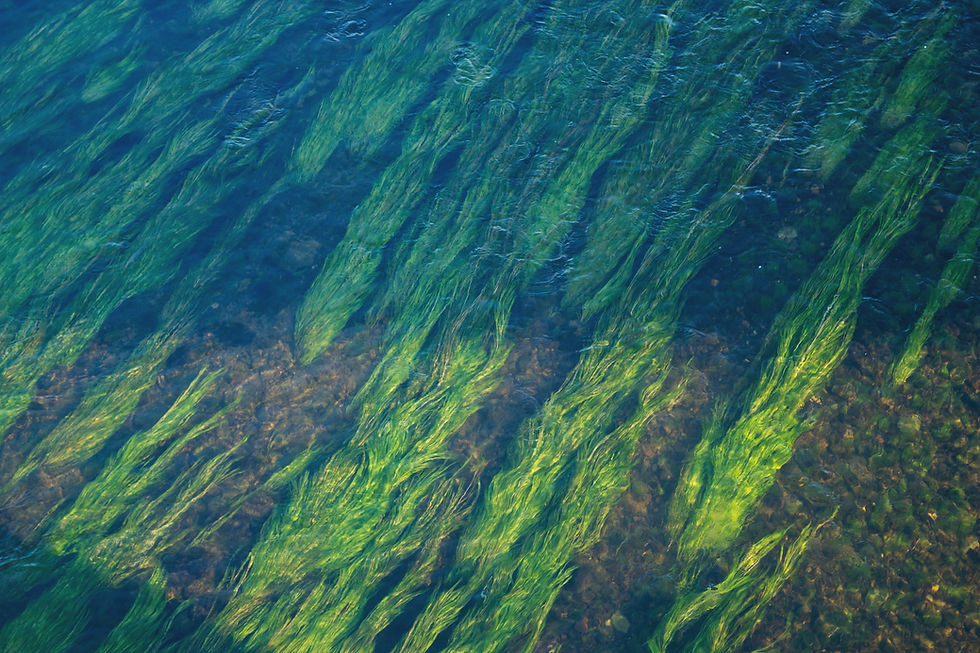
The distribution of seagrasses is vast, from the shallow New Zealand waters to Africa. Of the 12 known genera, 7 genera are located and spread in the tropics (Den Hartog, 1970). The highest diversity is in the West Indo Pacific region. The seagrass community in this region has a more complex diversity than the one in the region (Poiner & Robert., 1986).

The vegetative form of the seagrasses can show the character of a high degree of uniformity in which almost all genera have well-developed rhizomes and leaf forms that extend (linear) or very long shaped like belts, unless the type Halophila has an oval shape. These various forms of growth have to do with the ecological differences of seagrass (den Hartog, 1977). For example Parvozosterid and Halophilid can be found in almost all habitats, ranging from coarse sand to soft mud, from shallow to deep, from open sea to estuary. Magniumids are also found on a variety of substrates, but are limited to the sub-region to the lower tidal area. In general, the seagrass has the same outer shape, and that distinguishes between species is the diversity of vegetative organ forms. In contrast to seaweed (marine algae / seaweeds), seagrasses have true roots, leaves, internal vessels that are systems that deliver nutrients, water, and gases.
Seagrass beds have vital ecological functions in coastal ecosystems and strongly support and maintain coastal biodiversity and are more important as supporting coastal fisheries productivity. Some functions of seagrass beds, namely:
1) as aquatic stabilizers with the function of the stanchion system as a trap and stabilizer of the basic sediment so that the waters become more clear
2) seagrass becomes a direct food source of various marine biota (fish and non fish)
3) seagrass as primary producer
4) seagrass communities provide important habitat (shelter) and protection (shelter) for a number of animal species; and
5) seagrasses hold key functions in nutrient cycles and rare elements in the marine environment. (Phillips and Menez, 1988; Fortes, 1990).
REFERENCES
Den Hartog, C. (1970). "Sea grasses of the world" North Holland Publishing c o . , Amsterdam, London pp. 272
Phillips dan H.P.Calumpong. 1983. Sea Grass from the Philippines. Smithsonian Cont. Mar. Sci. 21. Smithsonian Inst. Press, Washington.
Poiner, I.R. & G. Roberts,.(1986) "A brief review of seagrass studies in Australia. Proc.National conference and Coastal Management. 2, 243-248.
Thomlinson, P.B. 1974. Vegetative morphology and meristem dependence - the Foundation of Productivity in seagrass. Aquaculture 4: 107-130.
Wood, E. J. F. , W.E. Odum and J. C. Zieman. (1969), Influence of the seagrasses on the productivity of coastal lagoons, laguna Costeras. Un Simposio Mem. Simp. Intern. U.N.A.M. - UNESCO, Mexico,D.F., Nov., 1967. pp 495 - 502.
"Jika Kamu tidak dapat menahan lelahnya belajar, | Maka kamu harus sanggup menahan perihnya Kebodohan." -Imam Syafi'i-


Comments